It is one of the most common questions we get at Surveyor Topographer: "Do I actually need a topographic survey for my planning application?" The honest answer is: it depends — but in more cases than you might think, the answer is a firm yes. And the consequences of getting it wrong can be very costly indeed.
Over my 22 years as a land surveyor, I've seen dozens of planning applications delayed, revised or refused — not because the design was bad, but because the site data underpinning it was inaccurate or incomplete. A topographic survey is not a bureaucratic formality. It is the factual foundation on which your entire planning case is built.
In this guide, I'll explain exactly when a topographic survey is required for planning permission in the UK, what it needs to include, what happens when you skip it, and how to commission one that satisfies your local planning authority first time.
What the Planning System Actually Says
The National Planning Policy Framework (NPPF) does not mandate a topographic survey for every planning application. However, local authorities have wide discretion to request supporting documents, and individual local validation checklists — which are reviewed regularly — often specify when survey drawings are required.
More importantly, even where a topographic survey is not explicitly listed as a validation requirement, planning officers will routinely request one when the site drawings appear inaccurate, incomplete or inconsistent. An application submitted with drawings based on an OS map — or worse, a rough sketch — is far more likely to receive a request for further information than one backed by a professional topographic survey.
The practical reality is this: if your site has any of the characteristics listed below, assume you'll need a topographic survey. Starting without one is, in my experience, almost always a false economy.
When Is a Topographic Survey Required for Planning Permission?
Local authorities commonly require or request a topographic survey in the following circumstances:
- Sites with significant level changes — if your site slopes or has a complex ground profile, planning officers will want to understand precisely how the proposed development relates to natural ground levels. Without accurate survey data, sections and levels drawings are unreliable.
- Flood risk zones — for any site in Flood Zone 2 or 3 (or within a critical drainage area), an accurate flood risk assessment is required, and this must be underpinned by precise topographic data. Environment Agency LiDAR is rarely sufficient for site-specific applications.
- Tree-sensitive sites — where trees are present within or adjacent to the development footprint, planning officers require a BS5837 tree survey. This must be combined with a topographic survey to show the relationship between proposed structures and the Root Protection Areas of affected trees.
- New dwellings and major extensions — particularly on sloping sites or where drainage design is a material consideration.
- Conservation areas and listed buildings — context drawings must be drawn to a high standard of accuracy to satisfy heritage requirements. Heritage officers rarely accept drawings not based on a proper survey.
- Large or complex sites — any application for substantial development, land development or change of use. Site layout drawings without accurate ground levels are virtually meaningless for planning purposes.
- Sites near watercourses or drainage constraints — where the relationship between proposed finished floor levels and flood/drainage risk must be demonstrated clearly to the planning officer and the Lead Local Flood Authority.
- Infrastructure and highways applications — road and footpath alterations, access junctions and public realm improvements all require precise ground level data.
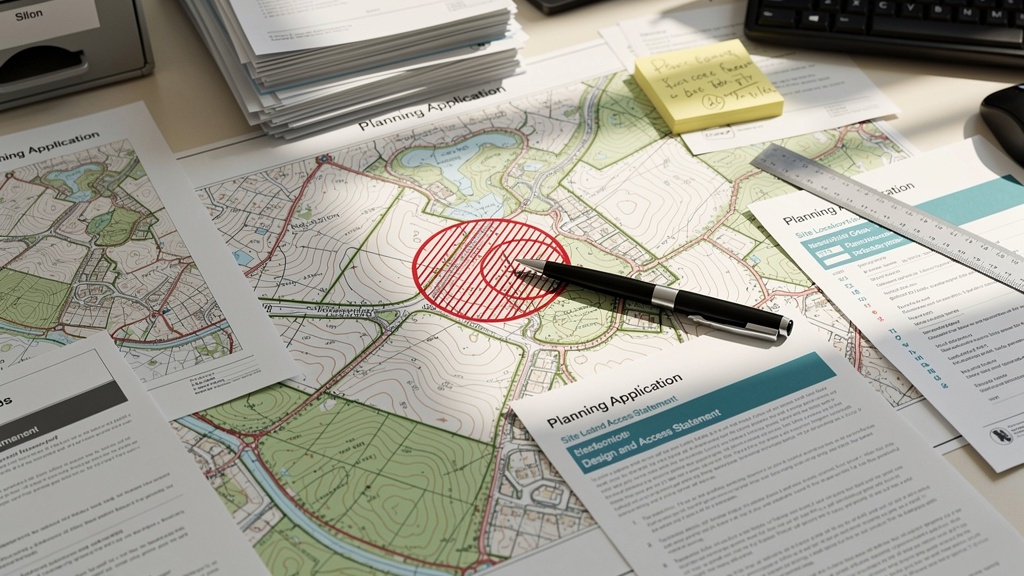
A Real-World Example: What Happens When You Skip the Survey
I want to share a story that illustrates exactly why this matters. In 2023, a developer client in Yorkshire attempted to submit a planning application for a small housing development of seven dwellings without a topographic survey. He'd used an OS map as the basis for his architect's drawings — which showed the site as broadly flat.
The local authority's planning officer requested a topographical survey as a condition of validating the application. When the survey was eventually carried out, it revealed a 1.8 metre level difference across the site that the OS map had simply not shown. The entire scheme had to be redesigned — the proposed drainage layout was wrong, the proposed road levels were incompatible with the adjacent highway, and one of the proposed buildings was sitting over a drainage culvert that had never been identified.
The result? A four-month delay, substantial redesign costs and a planning application fee the developer couldn't recover. Every penny of that loss could have been avoided with a topographic survey commissioned at the start — a survey that would have cost a fraction of the delay.
This is not an unusual story. Poorly defined site levels are one of the most common reasons planning applications are delayed or sent back for revision.
"Poorly defined site levels are one of the most common reasons planning applications are delayed — a topographic survey at the outset is almost always money well spent."
What Does a Planning-Grade Topographic Survey Include?
Not all topographic surveys are equal. A survey commissioned for a planning application needs to satisfy the specific requirements of planning policy and the expectations of planning officers. Here's what a planning-grade topographic survey typically includes:
Ground Levels and Contours
- Measured ground levels at sufficient density to model the site accurately — typically on a 5m or 10m grid for residential sites
- Contour lines at 0.25m or 0.5m intervals, depending on the slope and scale of the site
- Spot heights at key locations — threshold levels, ridge levels, adjacent finished floor levels, road and footpath levels
- All levels referenced to Ordnance Survey Datum (Newlyn) using OS national grid coordinates
Built and Natural Features
- All existing buildings on and adjacent to the site, including wall positions, finished floor levels and ridge heights
- All boundary features — fences, walls, hedges and their heights above ground
- Trees — position, species, estimated height, trunk diameter at breast height (DBH) and crown spread (to BS5837 standard if required)
- Watercourses, ponds, ditches and drainage features
- Roads, footpaths, access tracks, kerbs and hardstanding areas
- Underground services — drain runs, manhole positions, cover levels and invert levels
Survey Control
- Established survey control points, referenced to OS national grid and datum
- Sufficient control density for the site to be re-occupied for setting-out purposes during construction
- Survey specification document confirming accuracy, equipment used and datum reference

How Does a Topographic Survey Support the Planning Application?
A well-prepared topographic survey does much more than satisfy a planning validation checklist. It provides the design team with the factual data they need to produce accurate, credible planning drawings — and that makes a real difference to how planning officers assess an application.
Here's how the survey data feeds into the planning package:
- Site location plan and block plan — the topographic survey provides the accurate site boundary and context, properly referenced to OS grid
- Existing and proposed site sections — impossible to draw accurately without measured ground levels; these show the relationship between proposed development and natural ground, essential for sloped sites
- Drainage layout — drainage gradients must be calculated from accurate site levels; a wrong level of even 50mm can mean a drain runs uphill
- Flood risk assessment — requires accurate ground levels, watercourse data and datum-referenced floor levels
- Tree survey and arboricultural impact assessment — the tree positions and Root Protection Areas are overlaid on the topographic survey to show their relationship to the proposed development
- Design and Access Statement — references the survey data to describe site constraints, topography and how the design responds to them
Will My Architect Need the Survey Before Starting Design?
In an ideal world — absolutely yes. Architects and engineers should receive the topographic survey data before they begin any design work. Starting design without accurate site data is like trying to fit a bespoke suit to someone you've never measured. It might look right initially, but once it's put to use, the fit will be wrong.
In practice, some architects begin concept design work before the survey is available, which is fine as long as they treat it as genuinely provisional. But by the time any planning drawings are produced — especially site sections, drainage layouts and block plans — accurate topographic data is essential.
My strong recommendation: always commission the topographic survey at the very start of your project. Doing so will save your architect time, reduce design revisions and produce a planning application that planning officers can actually work with.
Understanding OS Maps vs Topographic Surveys
One of the most common mistakes we see is clients (and, unfortunately, some architects) using Ordnance Survey mapping as a substitute for a proper topographic survey. It's an understandable mistake — OS maps look detailed and authoritative. But they are not a substitute for a site-specific survey.
Here's why:
- Accuracy — OS maps are produced to a general national standard. They are not sufficiently accurate for design or planning purposes. Positional accuracy is typically ±1–3 metres — far too coarse for detailed design work.
- Currency — OS mapping is updated on a rolling programme and may be years out of date for any given site. New buildings, demolitions, boundary changes and earthworks may not be shown.
- Detail — OS maps do not show ground levels, tree sizes, drain positions, wall heights or any of the detail that a planning application requires.
- Legal status — an OS map has no legal standing for planning purposes. A topographic survey produced by a qualified surveyor, with a specification document, does.
For planning purposes, there is no substitute for a site-specific topographic survey. Full stop.
How to Commission a Topographic Survey for Planning
The process is more straightforward than many clients expect. Here's a step-by-step guide:
Step 1: Gather Your Site Information
Before contacting a surveyor, note down your site's postcode, approximate area (in hectares or square metres), and the nature of your project. If you have an existing OS map extract or any sketches, have them to hand — they're helpful context even if they can't be used as the basis for design.
Step 2: Define Your Survey Requirements
Think about what your planning application will need. Are there trees on site? Is there a flood risk element? Does the site slope significantly? The answers to these questions will determine the appropriate survey specification. If you're unsure, a good surveyor will advise you.
Step 3: Obtain a Fixed-Price Quote
A reputable surveying company will provide a written, fixed-price quote based on your site information. Be wary of quotes that are vague about what's included — the specification should clearly define the area to be surveyed, the features to be captured, the deliverable formats and the turnaround time.
Step 4: Commission and Schedule
Once you're happy with the quote and specification, commission the survey in writing and agree a site access date. For most residential sites, we can mobilise within five working days.
Step 5: Review the Deliverables
When you receive your survey drawings, review them against the specification before passing them to your architect. If anything is unclear or you think a feature has been missed, contact your surveyor promptly. A good surveyor will resolve any queries quickly and at no extra cost.
How Much Does a Planning Topographic Survey Cost?
Survey costs vary depending on the size of the site, the complexity of the survey and the level of detail required. As a rough guide:
- Small residential plot (up to 0.1ha) — typically £500–£900 + VAT
- Medium residential or garden site (0.1–0.5ha) — typically £800–£1,500 + VAT
- Larger development site (0.5–2ha) — typically £1,200–£3,000 + VAT, depending on complexity
- Complex or tree-heavy sites — add £300–£600 for full BS5837 tree data
- Flood risk surveys (with watercourse sections) — typically add £500–£1,500 to the base survey cost
These are indicative figures only. Contact us for a fixed-price quote specific to your site and project. We typically provide quotes within 24 hours of receiving your site details.
Common Planning Survey Mistakes to Avoid
After two decades of working on planning surveys, I've seen the same mistakes come up repeatedly. Here are the ones most likely to cause problems:
- Using an estate agent's floor plan as the site base — floor plans are not measured to planning accuracy and usually show only the building footprint, not the wider site
- Commissioning the survey too late — ordering a survey after the architect has already produced planning drawings leads to costly revisions and delays
- Under-specifying the survey area — only surveying the application site boundary, without extending to surrounding features that affect drainage, levels or tree Root Protection Areas
- Not referencing to OS datum — a survey that isn't referenced to Ordnance Survey datum (Newlyn) cannot be related to EA flood map levels or other publicly available data
- Assuming LiDAR is good enough — freely available EA LiDAR data is useful for strategic screening but insufficient for site-scale planning surveys
FAQ: Topographic Surveys and Planning Permission
Most UK local authorities accept CAD drawings in PDF format for planning purposes, with original DWG files available on request. We supply survey drawings at an appropriate scale (typically 1:200 or 1:500 for site surveys) and in a format suitable for inclusion in planning application packs. Drawings are always referenced to OS national grid and datum.
This is not advisable for any site with levels complexity, trees, drainage constraints or flood risk. Architect's sketches are not measured to the accuracy required for planning purposes, and planning officers are increasingly alert to inaccurate site drawings. An application based on inaccurate site data may be refused on that basis alone.
For most residential sites, we can mobilise within five working days and deliver finished drawings within ten working days of the site visit. If you have a tight planning deadline, let us know when you enquire and we'll do our best to accelerate the programme.
Permitted development rights don't require planning permission, so there's no formal need. However, if your project involves any significant groundworks, drainage work or structural elements — even under permitted development — a topographic survey will still be valuable for your architect and engineers to design accurately.
A topographic survey captures the land — ground levels, site features, trees, drainage and boundaries. A measured building survey captures the built structure — floor plans, elevations and sections of existing buildings. For a planning application that involves modifying an existing building as well as developing land, you may need both. We can carry out both simultaneously to save time and cost.
Survey data doesn't technically "expire," but it does become out of date if significant changes occur on site — new buildings, earthworks, new drainage, vegetation changes and so on. Local authorities generally accept survey data up to three years old, but if material changes have occurred on site since the survey was carried out, an update survey may be necessary.
Related Articles
Get a Planning Survey Quote
Tell us about your planning application and we'll advise on the right topographic survey specification and provide a free, fixed-price quote within 24 hours.
Get a Free Quote