Of all the professionals we work with at Surveyor Topographer, architects are the ones who most directly depend on the quality of our survey data. Every design decision an architect makes — from the orientation of a building on its site, to the drainage strategy, to the relationship with neighbouring structures — is grounded in site information. Get that information wrong, and the entire design is compromised.
In an ideal project, the topographic survey is commissioned at the very beginning, before the architect has drawn a single line. In practice, we often see projects where design has already begun — sometimes even reached planning stage — before accurate survey data is obtained. The cost of this sequencing error can be enormous: redesign fees, planning delays, additional planning application costs and, in the worst cases, expensive remediation works on site.
This article is written primarily for architects and their clients. It explains why a topographic survey at the outset of a project is not a luxury or a bureaucratic requirement — it is a fundamental prerequisite for good design practice.
What Information Does a Topographic Survey Give an Architect?
A well-specified topographic survey provides an architect with an accurate, scaled, CAD-format representation of the site they're designing for. More specifically, it provides:
Accurate Ground Levels
Ground levels across the site, presented as contour lines and spot heights. This is the foundation of every drainage design, every site section and every assessment of the relationship between proposed finished floor levels and natural ground. Without accurate levels, drainage gradients are guesswork and site sections are fiction.
Existing Building Information
The positions, dimensions and floor levels of all existing buildings on and adjacent to the site — not just within the red line boundary, but the wider context. Neighbouring buildings affect daylight and overshadowing assessments, party wall positions, overlooking and the visual impact of the proposed development.
Trees and Vegetation
Tree positions, heights, trunk diameters and crown spreads — the information needed to satisfy the BS5837 requirements of most planning applications and to understand the constraints on building placement. Trees affect not just the planning application but the structural design: Root Protection Areas constrain where foundations can be placed, and tree root investigations may be needed for piled foundations.
Boundary Positions
Precise positions of all boundary features — fences, walls, hedges, ditches — not as shown on a Land Registry title plan (which is imprecise) but as actually measured on site. Building close to a boundary requires accurate knowledge of where that boundary actually is.
Drainage and Services
Positions of manholes, drainage gullies, visible service covers and their relationship to the proposed development footprint. Knowing where existing drainage runs and what its gradients are is essential for designing connections and extensions.
OS Grid Reference
All survey data referenced to OS national grid and datum — so that the site drawings align correctly with OS mapping, can be used for planning applications, and can be integrated with data from other consultants (structural engineers, drainage engineers, flood risk consultants).

The Real Cost of Designing Without Survey Data
Let me describe a scenario that I've seen play out, in various forms, more times than I can count.
An architect is commissioned to design a single-storey rear extension and a new access to a suburban house. The client is keen to get the planning application in quickly. The architect visits the site, makes some sketched measurements, takes photographs and uses the OS map as the site plan background. Design proceeds, planning drawings are produced, and the application is submitted.
Three weeks later, the planning officer requests a topographic survey as additional information — the site has a level change that isn't shown in the drawings, and the relationship with an adjacent protected tree isn't demonstrated. The application is not validated. The architect commissions a survey. It reveals that the site falls by 1.2 metres across the proposed extension footprint, that two trees have Root Protection Areas that encroach significantly on the proposed extension, and that an existing drainage manhole is located beneath the proposed extension footprint.
The design has to be revised. The application is resubmitted — three months after it should have been validated. The additional fees? Redesign, second planning application, extended project management time. Total additional cost to the client: several thousand pounds and three months of delay.
The survey, commissioned at the start, would have taken ten working days and cost a fraction of the loss.
"A topographic survey at the outset is not a cost — it is an investment that pays for itself every time."
How to Specify a Topographic Survey for Architectural Design
The survey specification — what the surveyor is asked to include — determines the usefulness of the data for your design. Here's how to specify well:
Define the Survey Area Clearly
The survey area should extend beyond the red line boundary — typically by 5–10 metres — to capture the full context. Neighbouring buildings, road surfaces, drainage features and trees that are relevant to the design but sit just outside the boundary must all be included.
Specify the Required Level of Detail
For most planning applications, a survey that captures all built features, all drainage features, all tree data (to BS5837 if trees are present), all boundary features and all ground levels at sufficient density for 0.25m or 0.5m contours is appropriate. For more complex sites — heritage buildings, sites with significant existing structures — additional detail may be required.
Specify the Deliverable Format
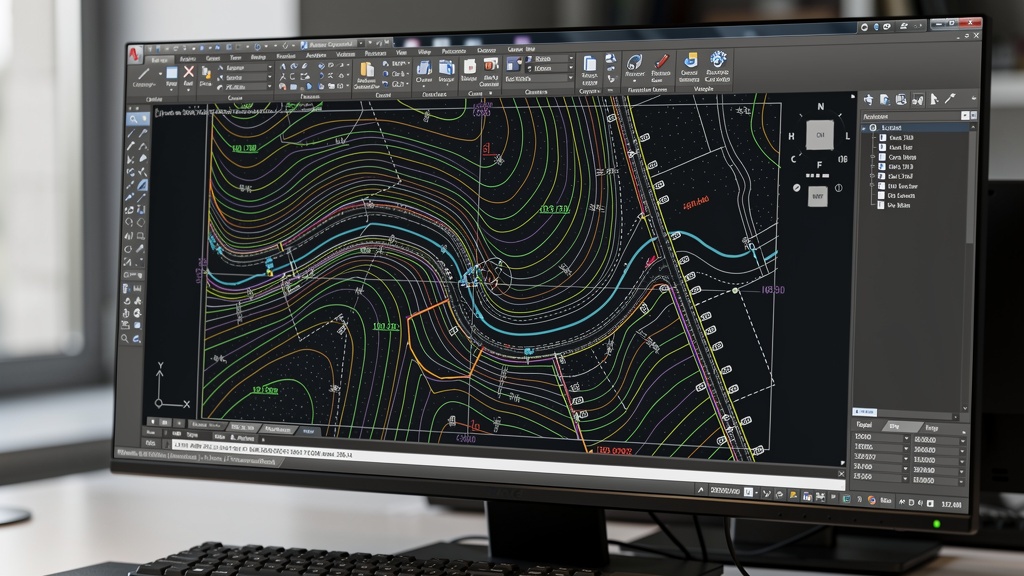
AutoCAD DWG is the industry standard. Specify the layer structure you want — particularly if you have a practice standard that the survey should conform to. If you work in Revit, specify that you want the survey delivered in a Revit-compatible format or as a linked DWG with the survey data on appropriate layers.
Request Existing Building Plans Where Relevant
If the project involves alterations to an existing building, specify a measured building survey as well as the topographic survey. The two surveys should be carried out simultaneously, sharing control points, so that the building plans are fully integrated with the site survey.
Confirm OS Grid and Datum Referencing
Always confirm that the survey will be referenced to the OS national grid and Ordnance Datum Newlyn (ODN). This ensures it will align correctly with all other data sources — OS mapping, EA flood data, utility records — and will be usable for the lifetime of the project, regardless of which consultants are involved.
Integrating Survey Data into Your Design Workflow
Once you have the survey, integrating it into your design workflow is straightforward — but there are a few practical points worth noting:
- Import the DWG at the correct units and rotation — survey drawings from reputable surveyors will be in metres at 1:1 scale. Ensure your CAD application is set to match before importing.
- Check the datum and grid coordinates — the survey should contain OS national grid coordinates (northings and eastings in hundreds of thousands of metres). If the drawing shows small-number coordinates, the survey may have been localised — this is fine for some purposes but limits its integration with OS and other datasets.
- Keep survey layers locked or separate — maintain the survey data on its own layer set, separate from your design layers. This makes it easy to update the survey data if revisions are needed without affecting design content.
- Use spot heights for level-critical design work — when designing drainage, floor-to-finished-floor heights and retaining wall heights, work from the individual spot heights on the survey rather than interpolating from contours.
When Does an Architect Need a Measured Building Survey Too?
A topographic survey covers the land; a measured building survey covers existing buildings. For projects that involve existing structures — refurbishments, extensions, conversions — both are needed, and both should be commissioned together.
Projects that typically require both a topographic and a measured building survey include:
- Extensions to existing residential properties
- Conversions of commercial, industrial or agricultural buildings
- Any planning application for work to an existing building where a full set of existing drawings is required
- Listed building consent applications
- Projects where the relationship between existing and proposed buildings is a material planning consideration
When both surveys are commissioned together, we carry them out as a single, integrated commission — the building plans and site survey share the same coordinate system and datum, and the deliverables are fully compatible and coordinated.
Working With Us: What Architects Can Expect
We work with architects every day, and we understand that fast turnaround, clean CAD data and easy communication are what you need. Here's what you can expect when you work with Surveyor Topographer:
- Free initial consultation — we'll discuss your project, advise on the appropriate survey specification and any site-specific considerations before you commit to anything
- Fixed-price, written quotation — no vague estimates; you'll receive a clear, written quote specifying exactly what the survey includes, the deliverables and the programme
- Fast mobilisation — typically within five working days of instruction for standard residential and commercial surveys
- Clean CAD deliverables — well-organised DWG files with consistent layer naming, OS-referenced, in metres at 1:1 scale
- Responsive communication — a named point of contact who knows your project and will answer queries promptly
- Support through the design process — if questions arise about the survey during design, we're always happy to discuss
FAQ: Topographic Surveys for Architects
Either works — it depends on your practice's approach and your agreement with the client. Some architects include survey coordination in their services and commission surveys directly; others advise clients to commission directly. What matters most is that it happens early, is properly specified, and that you receive data in the format you need. We're happy to liaise directly with you (as the technical lead) even if the contract is with your client.
Yes. We can carry out update surveys or supplementary surveys to capture changed conditions — earthworks, new drainage, demolished structures and so on. As long as we retain the original survey control points (or can re-establish them), an update survey is straightforward and faster than a full re-survey. Update surveys are charged on the same basis as new surveys, prorated for the work required.
Our topographic surveys can include BS5837 tree survey data — species, height, trunk diameter, crown spread, root protection area radius and condition category — for all trees on and adjacent to the site. This data is collected simultaneously with the topographic survey and integrated into the CAD drawing. You'll need an arboricultural consultant to produce the Arboricultural Impact Assessment and tree protection plans, but the survey data they need is part of our standard offering.
We deliver all surveys in DWG format at 1:1 scale in metres. You can plot or view them at any scale in your CAD application. For planning purposes, site surveys are typically plotted at 1:200 or 1:500 on A1 or A3 paper. For detailed design or listed building work, 1:50 or 1:100 is more appropriate. Just set your viewport scale when plotting — the data is in real-world coordinates regardless.
Yes — we regularly coordinate with the full project team. Planning consultants often ask us to confirm survey specifications for specific authorities; structural engineers need the ground level and feature data in specific formats for their calculations; drainage engineers need specific drainage feature data. We're happy to liaise with all parties and ensure our deliverables meet everyone's needs from a single survey commission.
Related Articles
Working on a New Project?
Tell us about your site and we'll advise on the right topographic survey specification and provide a free, fixed-price quote. Fast turnaround, clean CAD data.
Get a Free Quote