"How much does a topographic survey cost?" is almost always the second question clients ask us — right after "Do I need one?" And it's a fair question. Survey costs can vary considerably depending on the site, the project and the level of detail required, and online research often produces a frustratingly wide range of figures.
In this guide, I want to be as transparent as possible about what drives survey costs, what typical topographic survey costs in the UK look like in 2025, and what you should watch out for when comparing quotes.
I'll also explain why the cheapest quote is rarely the best option — and what questions to ask to make sure you're comparing like with like.
What Drives the Cost of a Topographic Survey?
Survey pricing is not arbitrary. It reflects the real cost of the work — the time spent on site, the time spent in the office processing and drafting the data, and the overhead costs of running a professional survey practice. Understanding the main cost drivers helps you understand why quotes vary and how to get the right survey at the right price.
1. Site Size
The larger the site, the more time the survey takes — both on site and in the office. This is the single biggest driver of survey cost. Doubling the area of land to be surveyed doesn't necessarily double the cost (because some elements of the survey are fixed costs), but it significantly increases it.
2. Site Complexity
A large, flat, open field with few features can be surveyed much faster than a similarly sized site with dense vegetation, complex drainage, multiple buildings, many trees and restricted access. Complexity adds time — and cost.
3. Level of Detail Required
A topographic survey specified to full planning standard — capturing all drainage features, all trees to BS5837 data, all boundary features, finished floor levels of adjacent buildings — takes longer than a basic contour survey. Always specify carefully what you need, because under-specifying will save money upfront but cost you when you discover the data isn't sufficient for your purposes.
4. Access
Sites that are difficult to access — steep terrain, dense woodland, restricted entry, poor roads — add time and cost. Remote sites also incur travel costs, though many surveyors (including us) include transparent travel pricing in their quotes for UK-wide coverage.
5. Deliverable Format
A standard topographic survey drawing (DWG and PDF) is the base deliverable. More complex deliverables — BIM models, 3D point clouds, BS5837 tree schedules, measured building plans combined with the topographic survey — add drafting time and cost.
6. Turnaround Time
Standard turnaround is typically five to ten working days. Rush deliveries — three to five days — cost more because they displace other work in the schedule. If you have a tight deadline, factor this into your budget.
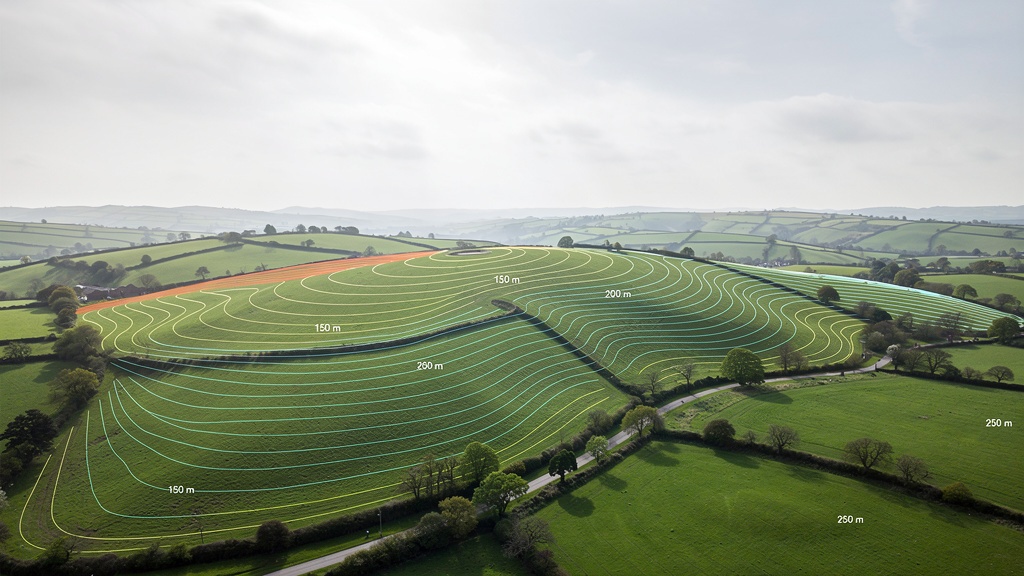
Typical Topographic Survey Costs in the UK (2025)
The following are indicative cost ranges for standard topographic surveys in the UK. All prices are exclusive of VAT (20% VAT applies to survey services).
Residential Plot Surveys
- Small back garden or side plot (up to 0.05ha) — £450–£750 + VAT
- Standard residential garden or small development site (0.05–0.1ha) — £650–£950 + VAT
- Larger residential plot or small development site (0.1–0.25ha) — £850–£1,400 + VAT
- Medium residential development site (0.25–0.5ha) — £1,200–£2,000 + VAT
Commercial and Development Site Surveys
- Small commercial site or urban redevelopment (0.5–1ha) — £1,800–£3,000 + VAT
- Medium development site (1–5ha) — £2,500–£5,500 + VAT, depending on complexity
- Large development site (5–20ha) — £4,000–£12,000 + VAT, depending on complexity and required detail
- Very large rural or agricultural site (20ha+) — priced by arrangement; drone survey may be more cost-effective for large open areas
Specialist Survey Add-Ons
- BS5837 tree survey data (integrated into topo survey) — typically adds £300–£700 + VAT depending on number and complexity of trees
- Watercourse cross-sections for flood risk — typically adds £500–£1,500 + VAT depending on watercourse length
- Measured building survey (concurrent with topo survey) — depends on building size and complexity; from £600 + VAT for a small residential building
- 3D laser scanning — see our 3D laser scanning guide for indicative costs
- Drone survey element (for large open areas) — typically adds £600–£1,500 + VAT to the ground survey cost for sites where drone is used for efficiency
What Should Be Included in the Quote?
A professional survey quote should clearly specify everything that is included — and by implication, everything that is not. Here's what to look for and ask about:
What's Included
- The survey area (hectares or square metres)
- The features to be captured — buildings, boundaries, trees, drainage, etc.
- The level of detail — contour interval, spot height density
- Datum and grid reference system (should be OS national grid and ODN datum)
- Deliverable formats (DWG, PDF, etc.) and scale
- Programme — site visit date, drawing delivery date
- Travel costs (are they included or extra?)
Questions to Ask
- "Does this price include VAT?" (Most quotes are + VAT)
- "Is travel included?" (Reputable surveyors include travel in most UK locations)
- "What happens if the site is more complex than anticipated?" (Reputable surveyors will discuss variations before incurring them)
- "Is the CAD drawing included, or just the field data?" (The drawing should always be included)
- "Is the survey referenced to OS national grid and datum?" (The answer should always be yes)
Why Is the Cheapest Quote Not Always the Best?
We get asked occasionally why our quotes are sometimes higher than the cheapest option a client has received. It's a fair question, and I want to answer it honestly.
Survey pricing reflects the quality and thoroughness of the work. A cheap quote may reflect:
- Fewer features captured — a surveyor who's cutting costs will simplify the survey, capturing fewer features and less detail. This may not be apparent until you find the data is insufficient for your design or planning application.
- Lower-quality equipment — survey equipment varies enormously in quality and capability. A survey carried out with low-grade instruments may not meet the accuracy standard you need.
- Insufficient experience — surveying is a skill. An inexperienced surveyor may miss features, misidentify elements or make errors in the datum referencing that invalidate the data.
- No professional indemnity insurance — professional surveyors carry professional indemnity insurance. If an error in the survey causes loss, their insurance covers it. Uninsured surveyors offer no such protection.
- Poor communication — a cheap survey that produces ambiguous or poorly organised CAD data costs your architect or engineer time in unpicking it.
A topographic survey is an investment. Getting a good survey costs £600–£2,000 for most residential projects. Getting a bad survey — and then having to redo it — costs the original survey fee plus the delay and any redesign fees incurred. Always check that the surveyor is adequately insured, experienced and will deliver to a clear, written specification.
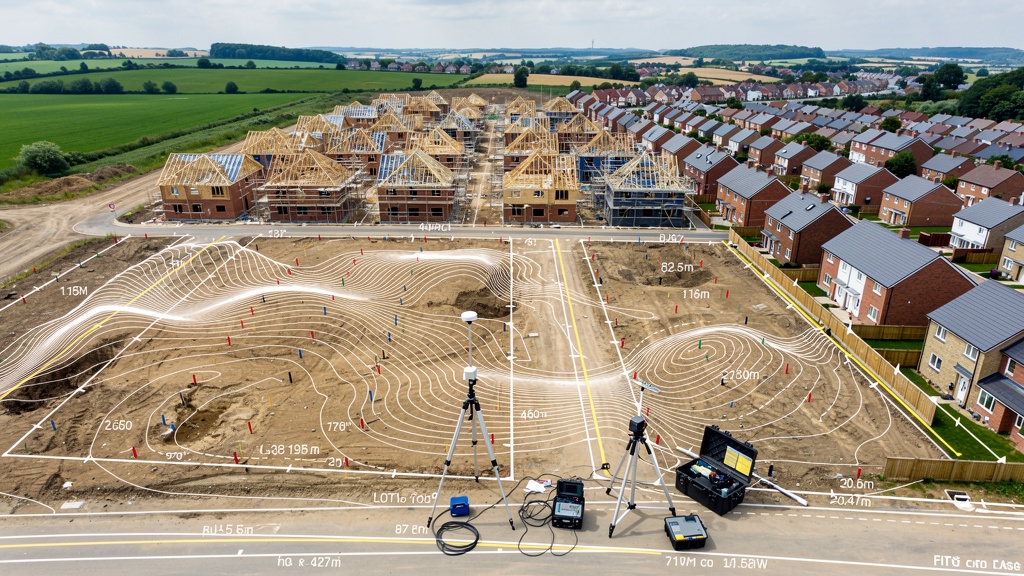
How to Get the Best Value from Your Survey Budget
Here are some practical tips for getting the best value from your survey investment:
- Commission early — the earlier you commission the survey in your project programme, the more value you extract from it. The same data that informs your planning application can be used for engineering design, drainage strategy and construction setting out.
- Commission once, use many times — a well-specified survey can serve as the base data for your architect, structural engineer, drainage engineer, flood risk consultant and landscape architect. Coordinate the specification with all consultants before commissioning to ensure the survey is useful to everyone — and you only need to commission once.
- Don't under-specify to save money — missing a key element from the survey specification (drainage features, tree data, adjacent building levels) typically results in a return visit to site, which costs more than including it in the original specification.
- Combine surveys where possible — if you need a measured building survey as well as a topographic survey, commissioning them together is more efficient and cheaper than commissioning them separately.
- Get at least two quotes — not to drive the price down, but to ensure you understand what's being offered. A significant difference in price usually reflects a difference in scope — compare the specifications carefully before choosing.
How to Request a Quote from Surveyor Topographer
Requesting a quote from us is straightforward. We need the following information to provide an accurate, fixed-price quotation:
- Site address or postcode
- Approximate site area (or a rough sketch/screenshot if you're not sure)
- Nature of your project (planning application, design, flood risk, boundary, etc.)
- Any specific requirements — trees, drainage, adjacent buildings, measured building survey, etc.
- Your required delivery date
We'll provide a written, fixed-price quote within 24 hours. No vague estimates, no hidden extras. Contact us or use the form on this page.
FAQ: Topographic Survey Costs
All our quoted prices are exclusive of VAT. VAT at 20% applies to all survey services. You should also check this when comparing quotes from other surveyors — some quote inclusive of VAT and some exclusive. Always confirm before committing.
Our quotes are genuinely fixed-price with no hidden extras. Travel costs for most UK locations are included. If site conditions are significantly more complex than indicated at the time of quotation — for example, if access is more restricted than described or the site is substantially larger — we would discuss any variation before proceeding. We never invoice more than the quoted price without prior agreement.
Yes — if you give us the approximate site size and the general nature of the project, we can give you a budget range over the phone or by email. This won't be a fixed-price quote, but it will tell you whether you're in the right ballpark before you spend time on a detailed enquiry.
For most residential and small commercial surveys, we deliver finished drawings within seven to ten working days of the site visit. For larger or more complex surveys, the programme is confirmed in the written quotation. Rush delivery (three to five working days) is available at a premium — please flag if this is required when requesting your quote.
For a very simple, flat, urban site with no trees and no drainage complexity, a survey may not be essential — your architect may be able to produce adequate measured drawings themselves. But for any site with a slope, trees, drainage features, flood risk or boundary complexity, a professional topographic survey is almost always worth it. The cost of a survey for a small residential plot (£500–£900 + VAT) is tiny compared to the cost of a planning refusal, a redesign or a construction error caused by inaccurate site data.
Yes — for architectural practices, developers and other professionals who commission surveys regularly, we can discuss preferred rate agreements. For volume commissions (multiple sites commissioned at once), we typically offer a reduction on the per-site rate. Contact us to discuss your requirements.
Related Articles
Get Your Fixed-Price Survey Quote
Tell us about your site and project. We'll provide a transparent, fixed-price quote for your topographic survey within 24 hours. No hidden costs, no surprises.
Get a Free Quote